Schedule Inspection
Use the calendar below to select a date & time convenient for you.
APPOINTMENT WINDOW: tech arrival time may vary by +/- 15 minutes (if your appointment is 9:00am, arrival window would be 8:45-9:15am)
Most roof budgets break for one reason: surprise work.
We build a five-year roof plan by listing every roof, checking its condition, ranking risk by what sits below it, and placing each project in the right year.
That helps you cut emergency spending, avoid stacked replacement costs, and keep routine work out of your capital budget.
Here’s the short version:

A simple five-year plan can help you avoid paying rush pricing, reduce repeat mobilization costs, and spot roofs that put tenant space, stock, or equipment at risk.
In other words: the goal is not to fix leaks one by one.
It’s to decide, in advance, which roofs need work, what kind of work they need, and when that work should happen.
That’s how we turn a roof portfolio from a budget problem into a scheduled asset plan.
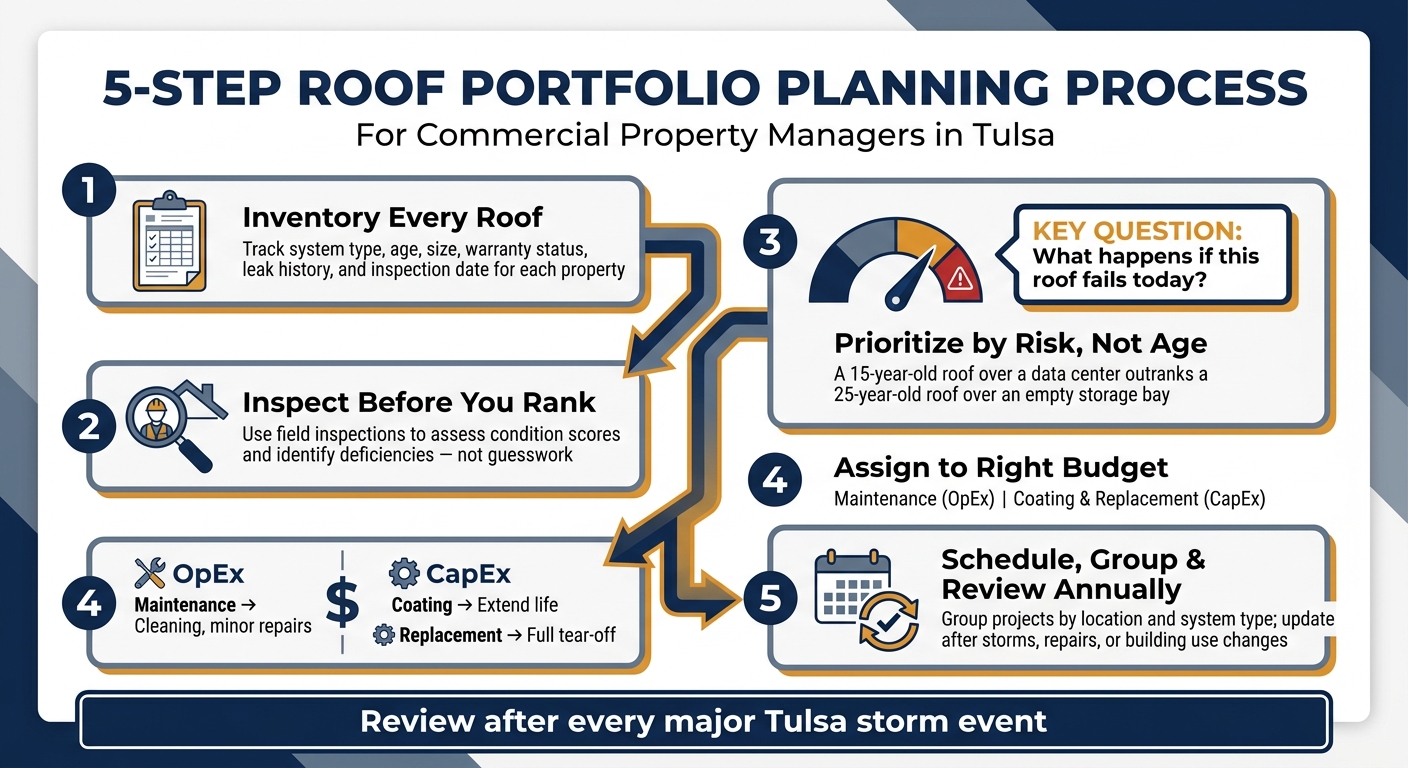
5-Step Roof Portfolio Planning Process for Commercial Properties
Once you know what you own, the next issue is how budgets get blown up.
Most portfolio roof budgets don’t fall apart because a roof hit a certain age.
They fall apart because of surprise work.
Without a plan, small leaks turn into emergencies that require immediate attention.
And emergencies cost more.
A roof doesn’t pause and check your capital plan before it starts leaking.
The roof with the most visible problem gets the money first.
Meanwhile, a roof three buildings over keeps getting worse, even though basic maintenance might have bought you more time.
By the time that second roof forces its way onto the agenda, your choices are tighter and the price tag is higher.
Emergency replacements bring a hidden process cost too.
When a commercial replacement happens on a rushed timeline, you often lose the breathing room for bidding, board approval, and tenant coordination that a planned project would include.
That coordination takes time.
It also adds friction.

This gets worse when each roof is handled as its own separate project.
Every unplanned replacement brings another mobilization, staging setup, notice cycle, and approval cycle.
Do that five times over five years instead of lining up the work on purpose, and you’ve paid for five separate mobilizations, staging setups, notice cycles, and approval cycles.
Grouping projects through a commercial roof maintenance plan turns that friction into a one-time cost instead of a recurring one.
Without a portfolio-wide view, several roofs can hit the same budget cycle at once.
That stacks capital pressure into a single year.
The way out is a portfolio schedule that ranks roofs before leaks decide the order.
That sets up the next step: a roof-by-roof baseline.

A five-year plan is only as good as the data behind it.
Before we rank roofs, we need a documented baseline.
That means more than a list of addresses.
We need the system type, installation date, warranty status, and the last documented roof inspection.
Without that, we’re ranking projects on gut feel instead of proof.
Track the fields that shape risk, timing, and scope.
Then update the register after every inspection, repair, or storm event.
| Field | What to Capture |
|---|---|
| Building ID / Name | Unique identifier for the property or section |
| Roof Area (sq ft) | Total roofing surface |
| System Type | Membrane and insulation assembly, such as TPO, EPDM, built-up, or metal |
| Installation Date | Month and year; note "Estimated" if records are missing |
| Warranty Status | Manufacturer and labor warranty expiration dates and any maintenance requirements |
| Last Inspection Date | Date of the most recent documented assessment |
| Condition Score | Numerical or letter grade based on current condition |
| Deficiencies | Active issues such as ponding water, open seams, or flashing gaps |
| Leak History | Past repairs, dates, and recurring problem areas |
| Critical Spaces Below | Notes on what sits under the roof, such as a data room, inventory storage, or tenant space |
Two fields make ranking much better: warranty status and critical spaces below.
Warranty status matters because it shapes your documentation needs and planning window.
Critical spaces below is what makes consequence-based ranking possible.
In other words, a roof over a storage room is not the same as a roof over a server room or tenant suite.
Once the register is in place, the next move is to document the condition baseline for every roof.
An internal register is a good start.
But it’s not a condition baseline.
Age alone won’t tell us if a roof needs maintenance, repair, or replacement right now.
We need a documented inspection.
We use commercial roof inspections for this.
We assess condition, identify deficiencies, and give you the documented baseline your capital plan needs.
You can also see our complete guide to commercial roof maintenance for the assessment process.
If your portfolio is large, start with the three roofs you’re most worried about.
Build complete records for those first.
Then expand the register over the next two quarters.
A partial register with accurate data beats a complete one built on guesswork.
That’s the baseline that lets us rank roofs by consequence, not just age.

Once the baseline is in place, we need to rank roofs by what failure would cost us, not just by how old the roof is.
A roof over a data closet does not carry the same risk as a roof over an empty storage bay.
The key question is simple: what happens if this roof fails today?
That shift changes how we set priorities.
| Factor | Age-Based Ranking | Consequence-Based Ranking |
|---|---|---|
| Primary metric | Years since installation | Failure impact |
| Priority example | A 25-year-old roof over a storage shed | A 15-year-old roof over a data center |
| Financial impact | May replace roofs that still have service life | Prevents high-cost downtime and equipment damage |
| Risk management | Ignores what is being protected | Focuses on what is being protected below |
In other words:
A younger roof can move to the top of the list if the space below it matters more.
That helps us avoid spending capital on the wrong asset while a higher-risk roof stays in service.

We also need a clean split between maintenance and capital.
Maintenance keeps the current roof doing its job.
Capital covers work that extends the roof’s life in a meaningful way or replaces it outright.
Cleaning drains, removing debris, and handling minor flashing repairs belong in maintenance.
A commercial roof maintenance plan helps keep that work on track.
Roof coatings fall somewhere in between.
On a stable aging system, they can restore performance and push replacement further down the road.
A full tear-off and new system installation belongs in a commercial roof replacement plan.
Wet insulation retains heat differently than dry insulation, which makes moisture easier to detect and deferred water intrusion a compounding problem.
That matters because a roof issue rarely stays small for long.
Water gets in, insulation changes, detection gets easier in some cases, and the cost of waiting starts to stack up.
| Category | Scope of Work | Budget Type | Goal |
|---|---|---|---|
| Maintenance | Cleaning drains, debris removal, minor flashing repairs, inspections | Operating (OpEx) | Support current performance and prevent premature failure |
| Roof Coating | Protective coating applied to an aging but stable system | Capital (CapEx) | Restore performance and defer full replacement costs |
| Replacement | Full tear-off and new system installation | Capital (CapEx) | Resolve critical deterioration and start a new system cycle |
Use that split to send each project to the right budget.
The hard part is not the concept.
It’s staying disciplined enough to keep routine upkeep out of capital, and full replacement out of maintenance.
Do that well, and the five-year sequence becomes much easier to map out.

Turn the inventory into a five-year sequence.
The goal is to place each roof in the right year based on access, staging, and how the building is used, not just this year’s budget.
Once you have the baseline, you can map out a schedule that makes day-to-day execution smoother.
The first big win comes from grouping roofs that can share staging, planning, and crew setup.
After you rank roofs by consequence, bundle the ones that make sense to handle together.
That usually means roofs that hit the same condition window during the same build phase, especially on the same campus or inside the same business park.
It also helps to group similar assemblies, like TPO roofs or built-up systems, so crews can stay in one work pattern instead of switching tools, details, and materials from job to job.
Plan approval cycles, tenant notices, and permitting early.
That small step can save a lot of friction later.
Even a solid sequence has to make room for Tulsa storm years.
A five-year schedule is a plan, not a fixed track.
Tulsa weather can change priorities fast.
For hail context, see our Tulsa hailstorm guide.
Storm damage can push a planned project to the top of the list.
Wet insulation holds heat differently than dry insulation, which makes moisture easier to spot and turns deferred water intrusion into a problem that grows over time instead of sitting still.
We document storm damage, provide inspection reports, meet with adjusters on site, and provide detailed estimates and scope-of-work documentation.
That paperwork gives you a factual baseline when the plan needs to be updated based on current field conditions.
If the revised plan still points to maintenance, a commercial roof coatings option may fit the decision.
If the damage has gone too far, the plan may point to commercial roof replacement.

The schedule should change when the portfolio changes.
A five-year schedule that never gets updated stops being useful.
Treat it as a living document.
Review it after a major storm, a major repair, a change in building use, or a warranty status change.
Annual roof inspections keep condition scores current.
A commercial roof maintenance plan keeps those inspections on a set cadence, so the schedule stays tied to actual field conditions instead of assumptions.
For a broader look at upkeep, see our complete guide to commercial roof maintenance.
Arrowhead Roofing is not a licensed public adjuster.
We do not negotiate insurance claims.
We provide roof inspections, document storm damage, and meet with insurance adjusters to support the inspection process.
Request a free inspection to get started.
Start with a full inventory of every roof across your Tulsa property portfolio.
Track the building name, square footage, membrane type, installation date, slope, drainage design, and warranty status.
Then use inspections to keep that condition data current.
From there, assign each roof a clear action: monitor, repair, or replace.
That gives you a better handle on capital planning before small issues turn into emergency calls.
Prioritize by condition and consequence, not age alone.
The oldest roof isn’t always the first one you need to deal with.
Use a full inventory and professional inspections to decide if each roof should be monitored, repaired, restored, or replaced.
A five-year capital plan helps you forecast needs, rank priorities, and avoid emergency costs.
We provide roof inspections, document storm damage, and meet with insurance adjusters to support the inspection process.
Update it whenever roof conditions change.
Start with a portfolio inventory.
Document each roof’s condition.
Then set a replacement forecast 5 to 10 years out.
From there, inspect on a set schedule.
For most portfolios, that means at least twice per year and after major storms.
Keep your records current so you can budget with fewer surprises and more control.
