Schedule Inspection
Use the calendar below to select a date & time convenient for you.
APPOINTMENT WINDOW: tech arrival time may vary by +/- 15 minutes (if your appointment is 9:00am, arrival window would be 8:45-9:15am)
A leak stain or an old-looking roof does not prove your roof has failed.
We look for three things first: where water got in, how far moisture has spread, and whether the deck and insulation are still sound.
That usually takes more than a walk on the roof.
In plain terms:

Here’s the short answer.
If damage is limited to one area, a repair may be enough.
If the roof is dry but worn, a coating may make sense.
If insulation is soaked, the deck is damaged, or the roof has multiple layers, replacement is often the next step.
The main point: Don’t make a $10,000 to $100,000+ roof decision from surface signs alone.
A useful report should separate what was seen, what was scanned, and what was confirmed by coring.
But there’s a catch.
An infrared scan is a screening tool, not final proof.
And a sales sheet with photos is not the same as a roof condition report.
| Tool | What it shows | What it cannot confirm by itself | Best use |
|---|---|---|---|
| Surface inspection | Seams, flashing gaps, punctures, ponding, visible wear | Wet insulation, deck damage, hidden layer issues | First look |
| Infrared scan | Areas that may have trapped moisture | Exact layer condition or exact cause | Find suspect wet areas |
| Core sample | Roof layers, insulation condition, moisture, deck condition | Moisture spread across the whole roof | Confirm what is inside |
| Condition report | Findings sorted into action steps | N/A | Decide on repair, coating, or replacement |
We use these tools together because the leak you see inside is often not where water entered the commercial roof.
A walk across the roof can spot open seams, flashing gaps, cracked vent boots, wind-lifted material, and blisters.
But it can’t tell you what’s going on under the membrane.
Under that top layer, you may have insulation, a vapor barrier, and the deck.
Trapped moisture, saturated insulation, and deck deterioration are all hidden from view.
So yes, a roof can look normal on the surface and still hide major damage underneath.

A surface check shows signs of trouble.
It does not confirm the whole failure.
Here’s the difference between what you can see from the top and what takes a core sample or scan to verify.
| Condition | Visible from Surface | Confirmed via Core Sample or Scan |
|---|---|---|
| Open seams and flashing gaps | Yes | Yes |
| Hail bruising and wind lift | Yes | Yes |
| Wet insulation | No | Yes |
| Number of existing roof layers | No | Yes |
| Deck damage | No | Yes |
| Insulation type and thickness | No | Yes |
| Failure below the membrane | Partial (via pooling) | Yes |
That’s why a surface walk is just the first step.
The stain you see inside is often nowhere near where the water got in.
On a low-slope system, water can slip through a weak seam or flashing, then move sideways along the deck or through the insulation before it drops into the building.
So by the time a ceiling stain shows up, the actual membrane breach may be far from that spot.
That’s the hard part.
A quick patch over the area above the stain often misses the real problem.
Our commercial roof leak detection process is built to trace water back to its actual entry point, not just the place where it finally appears inside the building.
When surface clues suggest damage below the membrane, the next move is a core sample.

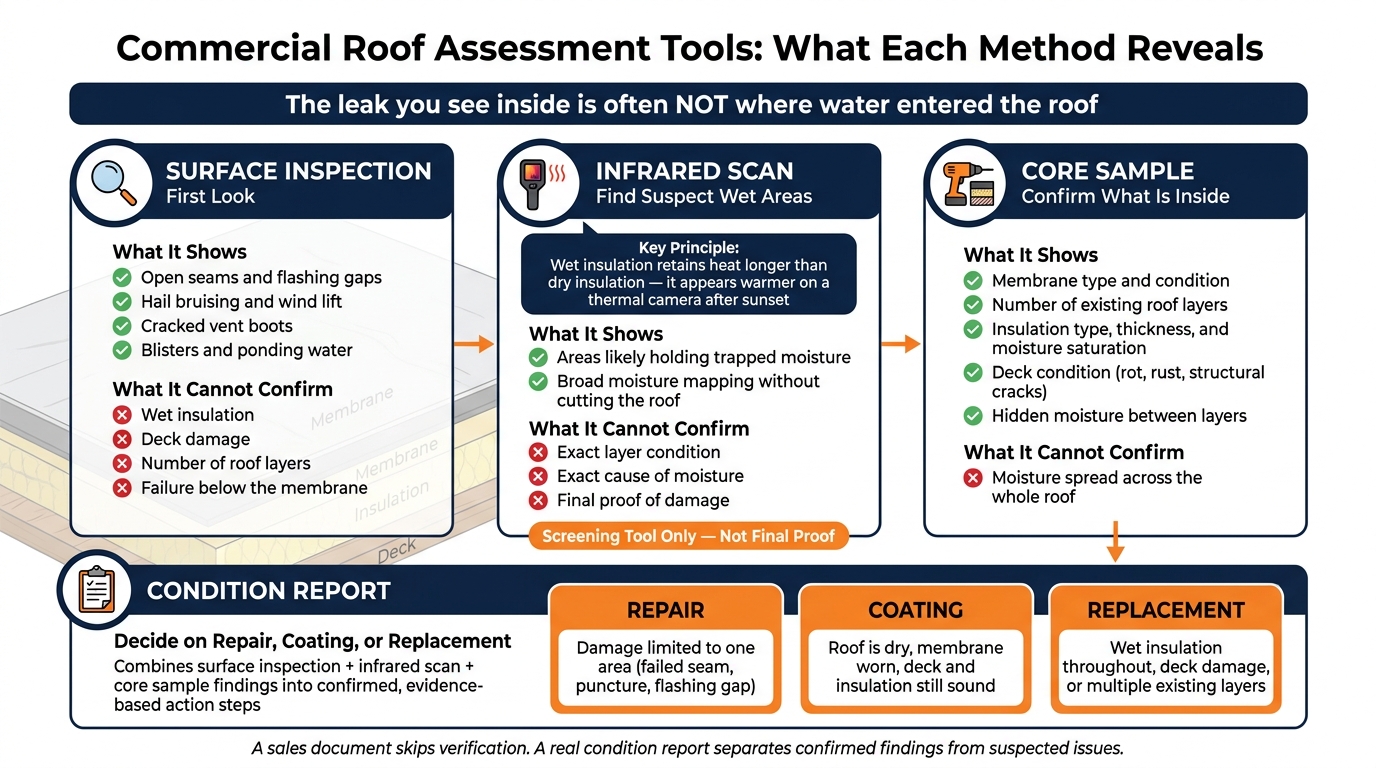
Commercial Roof Assessment Tools: What Each Method Reveals
Core samples and infrared scans answer different questions.
They work in different ways, and together they show what’s happening inside the roof assembly.
A core sample is exactly what it sounds like.
A technician cuts a small opening through the full depth of the roof assembly, removes the plug, and checks each layer in cross section.
That small cut can show the membrane, layer count, insulation condition, and deck condition.
It can also show hidden moisture trapped between layers, even when there’s no visible leak inside the building yet.
If the core reaches the deck, that layer matters just as much as the insulation above it.
Why?
Because the core can show whether the deck meets the standard for a solidly sheathed deck.
Oklahoma’s amendment defines that as sawn boards or structural panels that give solid holding power, excluding gaps wider than the manufacturer allows and boards that are warped, split, cracked, deteriorated, or rotten.
For more on what that finding means, see our guide on when roof decking needs to be replaced.
The opening is small.

The amount of information you get from it is not.
Once the core shows what is inside the assembly, infrared helps flag where moisture may be spread across the roof.
The physics behind an infrared scan is simple.
Wet insulation retains heat longer than dry insulation and releases it at a different rate.
After the sun heats the roof surface during the day, the roof starts cooling in the evening.
An infrared scan is a non-destructive screening tool.
It can map likely moisture across a broad area without cutting into the roof.
Dry areas cool faster.
Wet insulation holds heat longer, so it appears warmer on a thermal camera.
But there’s a catch.
Timing matters.
The contrast between wet and dry areas is strongest after sunset as the roof cools, so scans done at the wrong time of day can be unclear.
Used by itself, infrared is a screening tool, not proof.
In other words, it helps you find where to look next.
It does not give the final answer.
Infrared narrows the search area. Coring confirms what is actually there.
Neither method on its own should carry the full weight of a roof assessment.
The best read comes when surface observations, scan results, and direct physical verification through coring all line up before any big decision gets made.
If the leak path is still unclear, see our roof leak detection page.
Those findings lead to the next question: repair, coating, or replacement.

Core samples and infrared scans only help if the results are sorted by roof part.
Once the testing is done, the findings need to go into a report you can use.
Photos by themselves are not a condition report.
A good report turns scan and core results into plain, usable facts about the roof system.
Each part of a thorough condition report should focus on one piece of the roof system.
| Report Area | What it should address |
|---|---|
| Deck Condition | Deck type and signs of rust, rot, or structural cracks |
| Insulation Condition | Material type, thickness, and signs of moisture saturation, compression, or degradation |
| Membrane Condition | Membrane type and signs of UV damage, brittleness, or wear |
| Seams and Terminations | Integrity of welds or adhesives, and signs of lifting, separation, or pulled fasteners |
| Flashings | Condition at wall and roof transitions, and signs of gaps, rust, or deterioration |
| Drainage | Gutter and downspout function, plus pooling water or debris |
| Rooftop Penetrations | Seals around vent boots, pipe collars, and skylights, and signs of splits or weathering |
For more on what deck findings mean for your next step, see our guide on when roof decking needs to be replaced.
The clearest sign of a real condition report is simple: it separates confirmed findings from suspected issues.
Each finding should also show where it came from, whether that was coring, infrared, or surface inspection.
That matters because a useful report doesn’t just name a problem.
It explains why the problem matters.
For example, wet insulation can point to hidden damage below the surface.
A sales document skips verification and jumps straight to a replacement recommendation.
A real assessment looks at whether the roof may be a fit for repair, restoration, or replacement based on what the data shows.
If the report you were handed has no core sample data, no scan results, and no explanation of findings, the recommendations rest on assumptions, not evidence.
Those findings should guide the next step, not guess at it.

The findings should lead to one of three paths: repair, coatings, or replacement.
When coring and moisture results show a problem in just one area, a targeted commercial roof repair is often the right move.
A failed seam, cracked pipe boot, puncture, clogged drain, or flashing gap can often be fixed with a focused commercial roof repair.
If the issue goes beyond one spot, the next thing to check is whether the roof is still dry enough for restoration.
If the roof is still dry but the membrane has worn down, roof coatings may be a better fit.
Dry insulation and a sound deck matter here.
Why?
Because trapped moisture can weaken a coating system.
If the roof is wet all the way through, the deck is damaged, or there are multiple roof layers, replacement is usually the next step.
See our commercial roof replacement page for more on what that process involves.
If a report jumps straight to a recommendation without showing the findings behind it, that report is incomplete.
A useful roof inspection should make the next step clear.

There’s no one-size-fits-all number.
From the surface alone, you often can’t tell what’s going on underneath.
A commercial roof may look fine up top while hiding trapped moisture, soaked insulation, or more than one roofing layer.
Core samples and scans give you the proof you need to see what’s happening inside the roof assembly and make a smart call.
Yes.
You can’t always judge a commercial roof by what you see on the surface.
An infrared scan helps map potential wet areas below the membrane.
A core sample shows what’s actually inside the roof system, including the layers, the condition of the insulation, and any trapped moisture.
Used together, core samples and infrared scans let us look past the membrane and assess the roof based on evidence.
A roof condition report can sometimes save you from a full replacement.
Why?
Because a commercial roof can look bad on the surface and still have years left.
And the opposite is true too.
That’s where core samples and condition reports come in.
They help show what’s happening under the membrane, not just what you can see from a walk-through.
A core sample removes a small section of the roof.
That small cut lets us check the roof layers, insulation, and deck condition.
It also helps spot trapped moisture or hidden damage that may not show up from the top.
