Schedule Inspection
Use the calendar below to select a date & time convenient for you.
APPOINTMENT WINDOW: tech arrival time may vary by +/- 15 minutes (if your appointment is 9:00am, arrival window would be 8:45-9:15am)
Before you approve roof work, we recommend checking 3 things: what was found, where it is, and why it needs attention.
Your Tulsa commercial roof inspection report should help you:

Our rule: Ask for the findings behind each recommendation before approving the work.
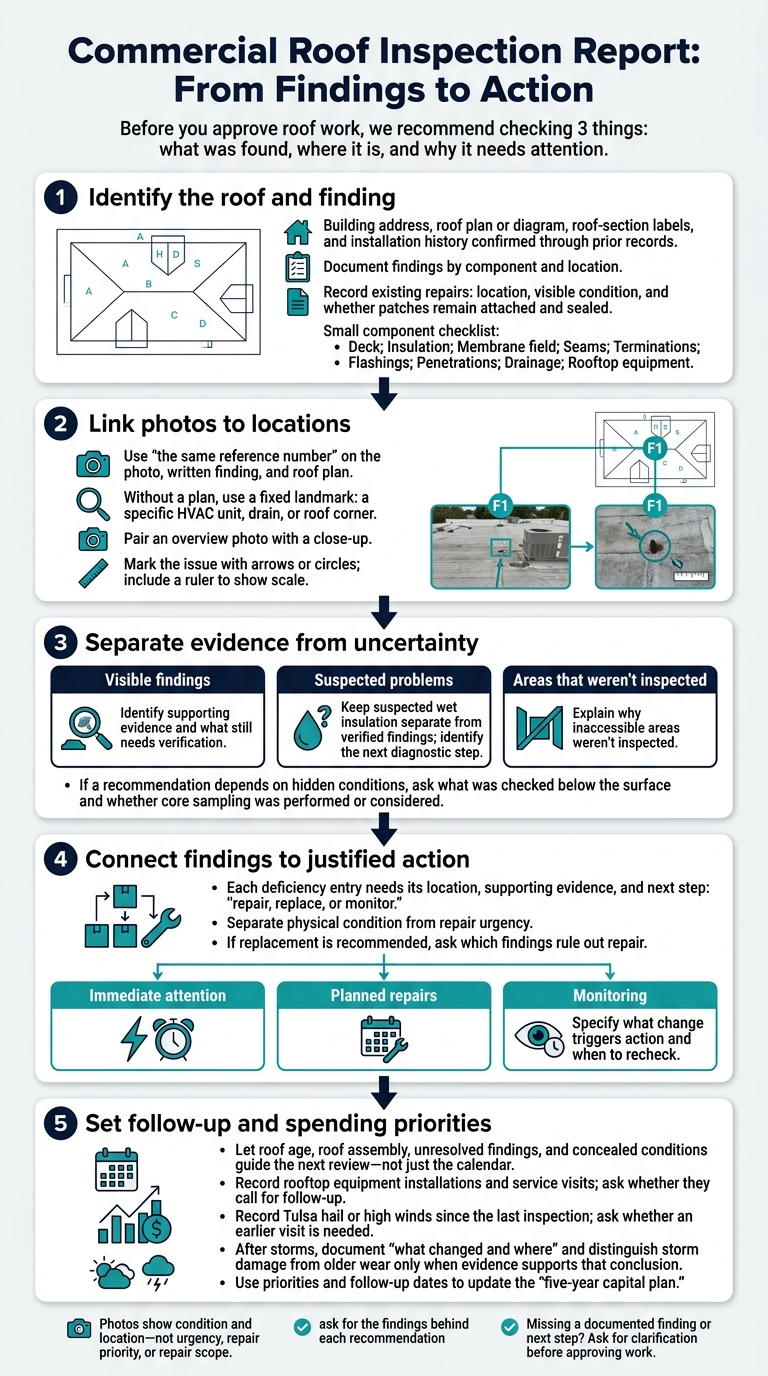
Commercial Roof Inspection Report: From Findings to Action
A commercial roof inspection report should start with roof identity: the building address, a roof plan or diagram, roof-section labels, and installation history confirmed through prior records.
From there, it should document findings by component and location so you can see exactly where each issue appears.
Existing repairs need a separate record of their location, visible condition, and whether patches remain attached and sealed. This gives you a baseline for tracking changes.

| Roof component | What the report should document | Why it matters |
|---|---|---|
| Deck | Visible rust, deterioration, or sagging, where accessible | Whether the deck needs further investigation |
| Insulation | Suspected moisture or compression, along with the inspection method used | Whether concealed conditions need verification |
| Membrane field | Surface wear, cracks, punctures, or blisters | Where the main roof covering needs attention |
| Seams | Open laps, separation, and any testing performed | Where water entry may start |
| Terminations | Pull-back or separation at edges and walls | Whether the perimeter needs closer review |
| Flashings | Condition at walls, curbs, and transitions | Which transitions need repair or further investigation |
| Penetrations | Condition of boots and seals around pipes and vents | Whether localized repairs should be considered |
| Drainage | Debris, blocked outlets, and observed standing water | Where water removal needs attention |
| Rooftop equipment | Condition around HVAC curbs and condensate discharge | Whether equipment-related conditions need investigation |
For each component, the report should separate visible findings from possible hidden damage, identify the evidence, and explain what still needs verification.
It should also identify any inaccessible areas and explain why they weren’t inspected.
Match every roof photo to a written finding and a fixed location, using the same reference number on the photo, finding, and roof plan.
If you don’t have a plan, tie the location to a fixed landmark, such as a specific HVAC unit, drain, or roof corner.
Use an overview photo to show the location and a close-up to show the detail.
Mark the issue with arrows or circles, and include a ruler to show scale.
Photos show condition and location – not urgency, repair priority, or repair scope.
Ask what evidence supports the recommendation and what still needs verification.

Once you’ve tied a defect to a location, separate its physical condition from its repair urgency – and explain why the recommended timing makes sense.
Each deficiency entry should include its location, supporting evidence, and next step: repair, replace, or monitor.
Base every commercial roof repair recommendation on documented findings, not urgent wording alone.
Keep suspected wet insulation separate from verified findings, and identify the next diagnostic step.
For anything marked “monitor,” specify what change would trigger action and when to recheck it, rather than treating every defect as an urgent repair.

Once the findings are tied to locations, we can check whether the recommendation follows the evidence – or skips straight to recommending a commercial roof replacement without showing the finding.
Question any report that lacks a roof plan, fixed locations, or drainage context: without these details, you can’t check the evidence behind the recommendation.
These gaps also hide what the inspector could not verify, so ask whether the missing evidence changes the recommendation.
If the recommendation depends on hidden conditions, the report should explain what was checked below the surface.
Ask whether core sampling was performed or considered, and what evidence would confirm the recommendation.

Your inspection report should guide the next review – not just the calendar. It should explain how roof age, roof assembly, unresolved findings, and concealed conditions affect inspection timing.
Anything the last report could not confirm should move the next review earlier.
Age helps you plan; it isn’t a deadline. If the report notes suspected moisture, ask whether it needs verification before the next scheduled visit.
Track rooftop equipment installations and service visits, and ask whether work near the roof calls for a follow-up inspection.
For unresolved findings that need monitoring, the report should explain what change triggers action and when to recheck. Use those follow-up dates to shape your commercial roof maintenance plans.
Storm history can shorten the inspection interval, even when the roof looks stable. Record any Tulsa hail or high winds since the last inspection, and ask whether they call for an earlier visit.
Use this seasonal inspection guidance to help plan your next review.

After a storm, your report should show what changed and where, pairing close-up photos with broader views keyed to an annotated roof plan.
A thorough report documents hail bruising, wind-lifted or creased roof covering, granule loss, dents on soft metal surfaces such as vent caps, flashing, gutters, and AC fins, and blocked drainage from storm debris.
This documentation helps distinguish storm damage from older wear, but only when the evidence supports that conclusion.
Arrowhead Roofing is not a licensed public adjuster, and we do not negotiate insurance claims.
We inspect roofs, document storm damage, and meet with insurance adjusters to support the inspection process.

Use your report to decide what happens next, and check that each recommendation includes a documented finding and a next step.
If either is missing, ask for clarification before approving the work.
If the report recommends replacement, ask which findings rule out repair.
Sort the work into immediate attention, planned repairs, and monitoring, then ask what could happen if you wait on each repair.
Use those answers to set priorities and update your five-year capital plan – not every finding needs urgent action.
Keep unanswered questions separate from confirmed repairs. Our guide to DIY inspections versus professional services can help you decide when to involve a professional.
If the leak source is still unclear, check whether a commercial leak is actually coming from the roof before approving the work.

Ask for any missing details so we can assess your roof’s condition and decide which work comes first.
A thorough report should include a roof plan showing defect locations, dated photos, a condition summary for each roof section, and recommendations grouped by urgency.
It should also record the roof area, the number of penetrations and drains, and any moisture survey results so you can track changes over time.
If you suspect roof damage, ask whether moisture testing makes sense for your roof.
A thorough commercial roof inspection report should mark any moisture survey results on an annotated roof plan.
It should also include dated photographs, identify roofing materials, and summarize the condition of each roof section.
Look for a clear split between immediate repairs, maintenance, and long-term needs.
Compare the documented findings – not just the recommendations. Review damage locations, photos, the roof’s overall condition, and how soon each issue needs attention.
A detailed report should cover the membrane, seams, penetrations, flashings, roof edges and metal, drainage, and rooftop equipment.
Storm damage documentation should also include photos.
Arrowhead Roofing is not a licensed public adjuster, and we do not negotiate insurance claims. We inspect roofs, document storm damage, and meet with insurance adjusters to support the inspection process.
