Schedule Inspection
Use the calendar below to select a date & time convenient for you.
APPOINTMENT WINDOW: tech arrival time may vary by +/- 15 minutes (if your appointment is 9:00am, arrival window would be 8:45-9:15am)
If your roof deck is solid, your insulation is dry, and the damage is limited, restoration or repair may work. If not, replacement is usually the safer call.
We look at one thing first: what’s happening under the surface.
That means checking the deck, insulation, seams, drainage, repair history, warranty limits, and code rules before anyone says, “coat it” or “replace it.”
Here’s the short version:

In other words: we decide by roof condition, not by the sales pitch.
| Check | Restoration may fit | Replacement may fit |
|---|---|---|
| Insulation | Dry or limited wet areas | Wet across large sections |
| Membrane | Minor cracks, wear, small blisters | Major seam failure or storm damage |
| Deck | Solid and dry | Damaged or weakened |
| Repairs | Past fixes have held | Leaks keep coming back |
| Drainage | Minor ponding | Ponding keeps returning |
| Code/Warranty | Coating or overlay still allowed | Roof layers or rules block that option |
For a Tulsa commercial roof, the big deciding factor is simple:
Is the roof base still stable and dry?
If the deck is solid, the insulation is dry, and the trouble spots are limited instead of spread across the whole system, restoration may be the right move.
That’s why the first step is always checking whether the roof is still worth restoring.
Restoration still works when the roof itself is sound.
A few leaks, small cracks, or localized blistering can often be repaired first and then coated.
In other words, a coating can buy more life for a roof that still has a solid base.
You can see the kind of work we mean on our commercial roof coatings page.
But there’s a catch.
Once those problems stop being isolated, restoration starts to lose the plot.
Replacement is the safer call when the roof shows widespread failure.
That includes saturated insulation, widespread seam failure, deck damage, and ponding water that keeps returning.
At that point, coating over the roof isn’t the right fix.
It may cover the symptoms for a while, but it won’t solve what’s happening underneath.
In that case, commercial roof replacement is the direct path.
The next step is figuring out exactly what condition the roof is in.

Restoration starts with the roof that’s already there.
That means the job isn’t just about putting on a coating.
It starts with prep.
And that prep decides whether the coating sticks and lasts, or fails where the roof was already weak.
The next step is simple: we need to know whether the roof can be cleaned, repaired, and coated without covering up bigger damage.
The order matters.
Before any coating touches the membrane, the roof surface needs to be cleaned and prepped.
Then the crew deals with every problem area.
That includes cracks, leaks, loose flashing, and seams on membrane roofs like TPO, EPDM, or PVC that need patching and resealing.
The coating goes on only after the repairs and prep are done.
It bonds to a clean, repaired surface.
If that work gets skipped or rushed, the coating can fail at those weak spots instead of protecting them.
And when those conditions aren’t in place, restoration is no longer the right move.
Some roofs should not be coated.
That needs to be said plainly.
Saturated insulation, seam failure across large areas, deck damage, and ponding water that hasn’t been fixed all rule restoration out.
Putting a coating over those problems doesn’t solve them.
It hides them.
Restoration works only when the roof base is still sound and the damage is limited to areas that can be repaired.
A few blisters, a small number of cracks, or flashing that needs work are the kinds of issues handled during prep and then coated over with good results.
Restoration makes sense only when the roof still has usable life left and extending that life is worth the work.
That’s why the next step is to check whether the roof still qualifies for restoration.

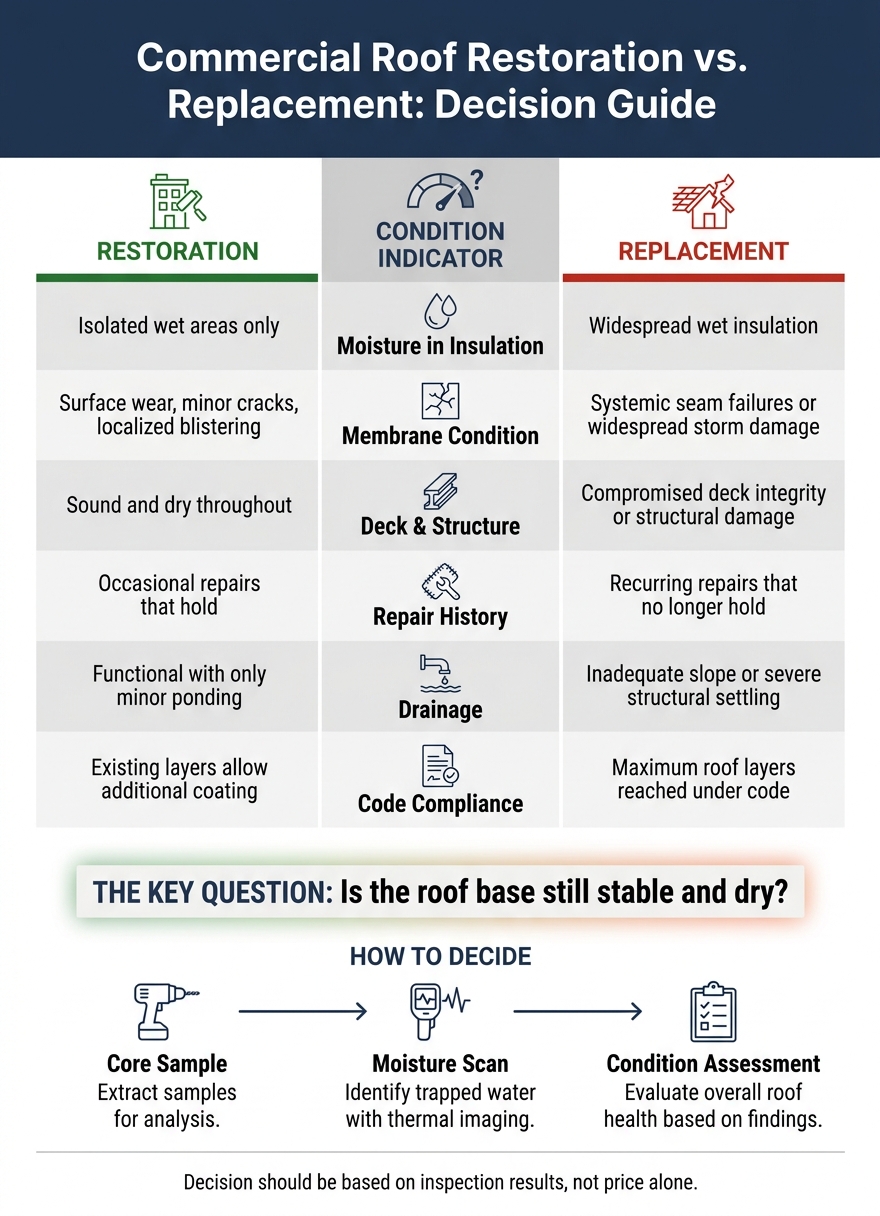
Commercial Roof Restoration vs. Replacement: Decision Guide
If the roof still looks like a fit for restoration, the next step is simple: check what’s going on under the surface.
This table lines up the roof conditions we see most often with the path they usually support.
At its core, the decision comes down to one thing: is the roof base still stable and dry?
Use this as a starting point, then verify the hidden layers before making the call.
| Condition | Points to Restoration | Points to Replacement |
|---|---|---|
| Moisture in insulation | Isolated wet insulation | Widespread wet insulation |
| Membrane condition | Surface wear, minor cracks, or localized blistering | Systemic seam failures or widespread storm damage |
| Deck and structure | Sound and dry throughout | Compromised deck integrity or structural damage |
| Repair history | Occasional repairs that successfully stop leaks | Recurring repairs that no longer hold |
| Drainage | Functional drainage with only minor ponding | Inadequate slope or severe structural settling |
| Code compliance | Existing roof layers allow an additional coating or overlay under applicable code | Building has reached the maximum roof layers permitted by code |
If the table leans one way or the other, don’t stop there.
The next move is to confirm what’s happening below the surface.
Surface wear only tells part of the story.
Core samples cut through the membrane and insulation layers, so we can see what’s happening underneath.
A moisture survey, using infrared or electronic scanning, shows where wet insulation is spread across the roof.
Put those together, and you get a clear answer: is the roof dry and sound enough for restoration, or does the damage go deeper than the surface suggests?
If you want a closer look at what a full assessment includes, our guide on whether it’s time for a commercial roof replacement walks through the indicators in detail.
To begin the assessment itself, visit our roof inspections page.

If the roof fails the hidden-layer check, replacement is usually the cleaner path.
From there, the focus shifts to membrane choice and how the building is used.
TPO is our default membrane for most commercial work.
Its reflective surface and heat-welded seams make it a common fit for many buildings.
But there’s a catch.
A restaurant or a building with chemical exposure may need a different membrane than a standard office or retail building.
Our membrane comparison guide compares TPO, EPDM, and PVC side by side.
And our commercial roof replacement page gives an overview of the full process.

Once an inspection shows the roof is still in that decision range, warranty terms and code can still shift the call.
A new membrane system comes with one type of warranty.
A coating comes with another.
Commercial construction in Oklahoma follows the 2018 IBC, and that matters.
In plain English, a full replacement can set off code requirements that a coating may not.
That said, warranty and code do not outrank roof condition.
They matter.
But they should never be the only reason to go one way or the other.
When restoration is still being considered, the condition check is the last word.
If the insulation is wet, seams are failing across large sections, or the deck is compromised, we recommend replacement.
If the roof fails the condition check, replacement is the right move.
No dancing around it.

Restoration works when the roof is still sound and the problem is mostly at the surface.
Replacement makes more sense when the failure goes deeper.
The right decision comes from what the inspection shows: core samples, moisture scanning, and a clear read on the deck and insulation.
Not from whichever option looks cheaper on paper.
And not from a contractor who starts with a coating quote before even checking the roof.
If you want to see what a coating contractor should review before any product is applied, our guide on what to look for in a roof coating contractor is a good place to start.
Sometimes it can, but it depends on the roof’s condition.
A coating may be used as part of a restoration after leaks or flashing issues are repaired, but it only makes sense when the roof underneath is still in good shape.
If the system is at the end of its functional life or has major damage, replacement is the right move.
Request a free inspection for a professional assessment.
They help us assess your roof’s condition so you can choose between restoration and replacement.
Restoration means cleaning the roof surface, fixing problem areas, and adding a protective coating to help the current system last longer.
Replacement means putting in a new roof system when repairs or restoration no longer make sense because the roof has major damage or has reached the end of its service life.
If only part of your roof is wet, the main issue is whether the rest of the roof is still in good shape.
Restoration can make sense when the structure underneath is still sound and the trouble is limited to one area that repairs can fix.
Replacement makes more sense when the roof has damage across a lot of the surface, heavy moisture soak-through, or framing and decking issues that patchwork won’t solve.
Request a free inspection to see what your roof needs.
