Schedule Inspection
Use the calendar below to select a date & time convenient for you.
APPOINTMENT WINDOW: tech arrival time may vary by +/- 15 minutes (if your appointment is 9:00am, arrival window would be 8:45-9:15am)
Before we replace your Tulsa daycare’s roof, we need a plan for the children below it. We start with nap times, classroom use, playground routes, and drop-off and pickup windows – not just a roofing schedule.
With you, we’ll plan for:

Working after closing does not settle every odor concern. We’ll review return-to-room conditions, permit questions, and <u>who signs off before children return</u> before setting dates.
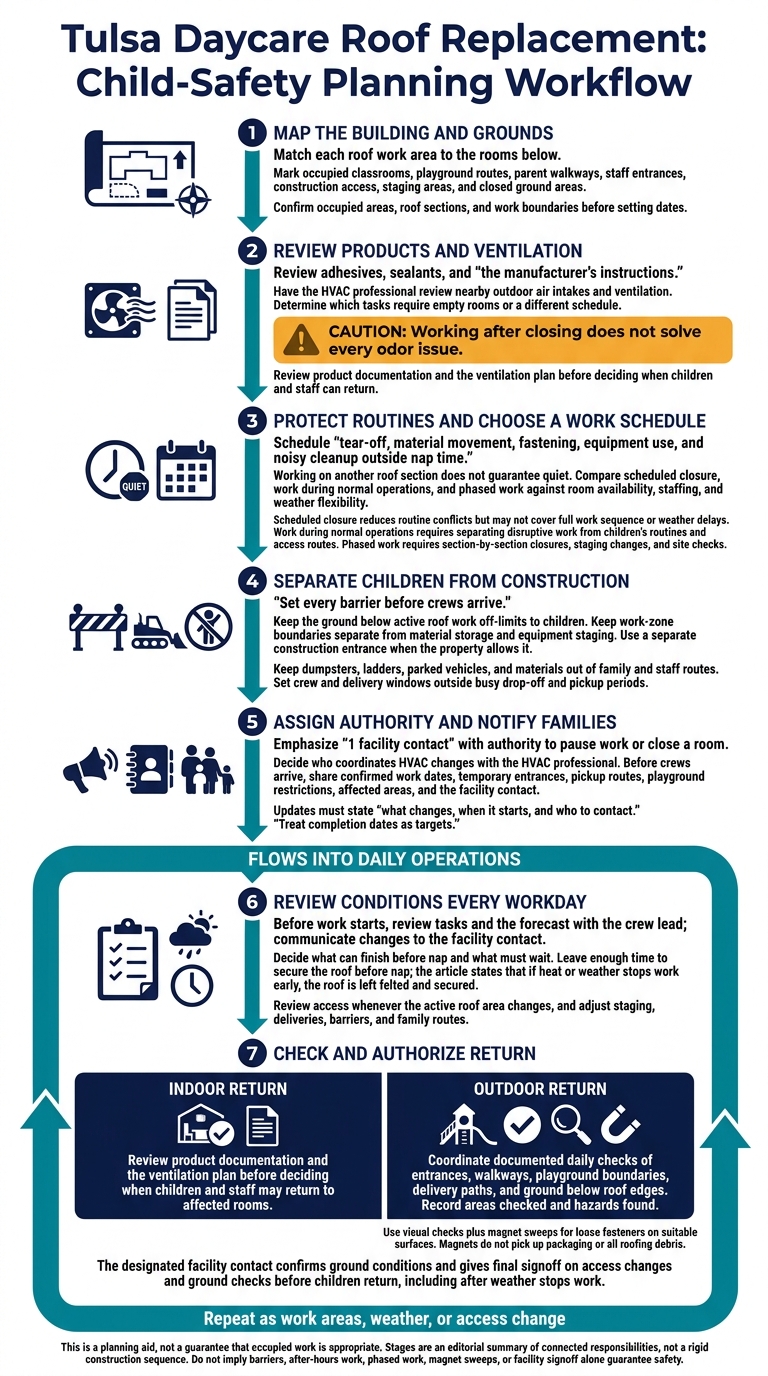
Tulsa Daycare Roof Replacement: Child-Safety Planning Workflow
Before work starts, ask us which adhesives and sealants we’ll use above occupied rooms.
Review the manufacturer’s instructions to determine whether work can proceed above occupied rooms or needs a different schedule.
Match each roof work area to the rooms below, and have your HVAC professional review nearby outdoor air intakes and ventilation.
For rooms beneath the work, plan ventilation before crews begin.
If the product plan affects the room schedule, leaders can decide whether to empty rooms or move the work to after hours.
Account for nap time and outdoor play when making those changes.
Working after closing does not solve every odor issue.
Review the product documentation and ventilation plan before deciding when children and staff can return to affected spaces.
Choose one facility contact with the authority to pause roofing work or close a room.
Decide in advance who will coordinate HVAC changes with your HVAC professional.

Schedule tear-off, material movement, fastening, equipment use, and noisy cleanup outside nap time.
Working on another roof section doesn’t guarantee quiet: footsteps and tools can still carry sound through the roof deck, so review planned tasks before promising staff a quiet building.
Before work starts, review the day’s tasks and forecast with the crew lead, and send any daily changes to one facility contact before crews begin.
Use that morning review to decide what can finish before nap and what must wait.
Heat or weather can change the work sequence, so leave enough time to secure the roof before nap rather than starting tear-off too late.
If heat or weather stops work early, we leave the roof felted and secured.

Once we’ve planned for indoor disruptions, we need to map where children can go outside.
Walk the grounds with us before work starts to mark construction access, class routes to the playground, and ground areas that will close during roof work.
Use that map to set every barrier before crews arrive.
Keep the ground below active roof work off-limits to children, with boundaries separate from material storage and equipment staging.
Ask whether crews can stage equipment and materials outside the playground so it can stay open.
Coordinate daily access through one facility contact so crews know which areas are open and which are closed.
Before reopening any closed area, check the ground for nails, scraps, and other roofing debris.
The designated facility contact should confirm that the ground is clear before children return.
Use the playground map to plan crew traffic around drop-off and pickup.

After you map the playground, plan arrival and departure traffic so roofing work stays out of your busiest drop-off and pickup periods.
Set crew and delivery windows before work starts. Include crew arrivals and departures, material deliveries, and vehicle movement to keep routes clear for parents, staff, and children.
Review parent walkways, staff entrances, and vehicle routes with us each morning, and reschedule late deliveries before they reach the property.
Use a separate construction entrance when the property allows it.
Keep dumpsters, ladders, parked vehicles, and materials out of parent walkways, staff routes, and drop-off and pickup lanes.
Review access whenever the active roof area changes. A staging area that works for one roof section may block access to the next.
Check routes before moving equipment or rerouting families, and adjust access as the roof work moves.

Cleanup should cover loose fasteners, roofing debris, and packaging on surfaces children walk on, touch, and cross.
We also check for storm debris that may hide hazards.
Set locations for debris and stored materials between shifts, and update the cleanup review whenever storage moves.
Assign a facility contact to coordinate documented daily checks with us before children return outside.
Record which areas were checked and any hazards found.
Check entrances, walkways, playground boundaries, delivery paths, and the ground below roof edges, focusing on surfaces children use.
Use magnet sweeps for loose fasteners on suitable surfaces, alongside visual checks.
Magnet sweeps won’t pick up packaging or all roofing debris, so the daily review should account for that day’s roof activity.

Once we’ve mapped the commercial roofing worksite, parents need the same plan in writing.
Send the notice to parents and staff before crews arrive.
Use your usual parent communication channel to share confirmed work dates, temporary entrances, pickup routes, and playground restrictions.
List the classrooms, entrances, and outdoor areas affected that day, and name one facility contact for questions and updates.
If access, outdoor restrictions, or the timing of disruptive work changes, send an update that states what changes, when it starts, and who to contact.
Treat completion dates as targets.

With access routes and closed areas mapped, compare your facility calendar and staff availability against the work sequence before setting dates for commercial roof replacement.
A closure window can help, but weather may still interrupt the work.
| Scheduling approach | Advantages | Planning limits |
|---|---|---|
| Scheduled closure | Reduces conflicts with children’s routines | May not cover the full work sequence or weather delays |
| Work during normal operations | Keeps the building occupied | Requires separating disruptive work from children’s routines and access routes |
| Phased work | Limits work to one section at a time | Requires section-by-section closures, staging changes, and site checks |
Before deciding to stay open, map roof sections to the classrooms below.
Use that map to check whether your available spaces and staffing can support phased work.
Give a scheduled closure a closer look if you can’t separate children’s activities from disruptive work.
Discuss which tasks fit within that window, allow flexibility for weather interruptions, and decide which areas can reopen if work continues after children return.

After comparing closure windows, confirm the remaining details before setting dates.
Use commercial asphalt shingle roofing for shingle roofs and commercial TPO roofing for low-slope buildings.
TPO is our default commercial system, but it isn’t right for every building.
Ask which adhesives, sealants, and tasks require spaces to be unoccupied.
Direct project-specific permit questions to the City of Tulsa Development Services Department.
Confirm occupied areas, roof sections, and work boundaries.
Name one facility contact to give final signoff on access changes and ground checks before children return – including after weather stops work.
Our roofing considerations for schools offers related planning guidance.
With those boundaries set, focus the remaining questions on material choice and who’s responsible for what.

For your Tulsa daycare or preschool, we can help you weigh a scheduled closure against phasing work around naps, drop-off, pickup, and outdoor time.
That means planning for noise, odors from adhesives and sealants, and keeping children away from work areas.
We schedule around those needs, based on which tasks fit your daily routine and which don’t.
Request a free inspection.
Let us know so we can review the work schedule with you.
Odors from adhesives and sealants are a concern when roofing work takes place above occupied classrooms.
We coordinate work on roof sections with the occupied areas below and plan around your schedule, including naps, drop-off, pickup, and outdoor time.
If weather cuts work short, we never leave the roof open: we cover it with felt and secure it before stopping.
We coordinate work on-site to limit disruption while protecting the building and keeping children safe.
