Schedule Inspection
Use the calendar below to select a date & time convenient for you.
APPOINTMENT WINDOW: tech arrival time may vary by +/- 15 minutes (if your appointment is 9:00am, arrival window would be 8:45-9:15am)
Yes, you can replace an industrial roof in Tulsa without stopping the whole plant.
We do it by splitting the roof into zones, tying each zone to the work below it, and closing each section before the shift ends.
The main goal is simple: protect production time, not just control roof cost.
Here’s the short version:
A roof leak can cost far more than the roof itself if it hits product, slows shipping, or puts equipment at risk.
In many plants, even 1 to 2 hours of lost production can outweigh a big part of the project budget.
The hard part is how to do it.
We keep it under control with tight phasing, dust and debris control, daily shutdown checks, and zone-by-zone scheduling. Long-term reliability is then managed through commercial roof maintenance plans.
If you need a fast snapshot, start here:
| Focus Area | What matters most |
|---|---|
| Production uptime | Keep most lines running while work moves by section |
| Live-floor protection | Control dust, debris, moisture, and fasteners |
| Equipment planning | Time HVAC, exhaust, vents, and dock access before each zone opens |
| Work window | Choose day shift, off-shift, or shutdown based on plant limits |
| Pre-job planning | Lock in access, staging, contacts, and phase sign-off |
| Membrane choice | TPO for most jobs; PVC or EPDM for certain conditions |
In other words: the roof gets replaced, and your plant keeps moving because the sequence is built around your floor – not our crew.

If your floor stays live, each tear-off zone has to protect the work below.
That’s why we map the roof plan to the floor layout before tear-off starts.
Debris control and fastener control are non-negotiable from day one.
Old membrane, insulation scraps, and dust can contaminate product, packaging, and fixed equipment.
Each opened zone should be sealed back up before the shift ends.
If weather threatens, secure the area with a temporary cover.
Before tear-off starts in any zone, identify sensitive products, packaging, and fixed equipment.
Then protect them, move them, or isolate them.
Keep forklifts and other vehicles out of the active zone until it is sealed.
Check ceiling-mounted systems below the active zone before and during tear-off.
HVAC units over active work zones should be shut down during the shift so they don’t pull dust or moisture into the facility.

The roof schedule should match the floor schedule.
If a bay handles sensitive work, schedule that area around planned downtime or off-shifts.
If a dock needs to stay open for shipping, don’t block it with crane placement or material staging.
Mapping roof zones to your production layout is how we set the project sequence.
Storage lanes, production cells, docks, and maintenance corridors all shape which roof section gets opened on which day.
Then we match each roof zone to the production area below it.
From there, we phase the work by bay and by equipment, not by crew convenience.

Once the roof zones line up with the floor layout, phase the job by bay and by equipment.
That way, each roof zone ties to one production area and one equipment plan.
It keeps the work tighter.
And it cuts down on spillover into parts of the plant that don’t need to be touched.
Match each roof zone to the space below it.
The goal is simple: only one department is exposed at a time.
When a zone maps cleanly to one production area, it’s much easier to control dust, noise, access, and downtime.

In many cases, the rooftop equipment sets the order of work.
HVAC and make-up air units, exhaust fans, dust collection systems, and process vents often need shutdowns or close coordination before work starts in that zone.
Some units must be shut down before tear-off.
Others need a timed restart after the zone is sealed back up.
That’s where internal coordination matters.
Bring in facility, operations, maintenance, and safety staff early for decisions on shutdowns, restarts, access, and daily checks.

Use this table to match each system with the shutdown, bracing, or access steps it needs.
| Equipment Type | Coordination Needed | Who Is Involved | Approval Needed |
|---|---|---|---|
| HVAC / Make-up Air Units | Shutdown to block moisture or debris, and seal intake vents. | Facility Manager / HVAC Tech | Yes (Restart) |
| Exhaust Fans | Temporary shutdown during membrane application. | Operations Manager | Yes (Shutdown) |
| Dust Collection Systems | Coordination of vibration-sensitive work; temporary duct bracing. | Maintenance Supervisor | No |
| Process Vents | Coordination with active production cycles; fume control. | Production / Safety Manager | Yes (Both) |
| Fire Sprinkler Systems | Daily debris inspection below open zones; temporary shielding of heads. | Safety Officer | Yes (Daily Check) |
| Loading Docks | Crane positioning and bay closure scheduling. | Logistics / Shipping Manager | Yes (Access) |
With the sequence set, the next call is how each zone will run: during production, off-shift, or during a planned shutdown.
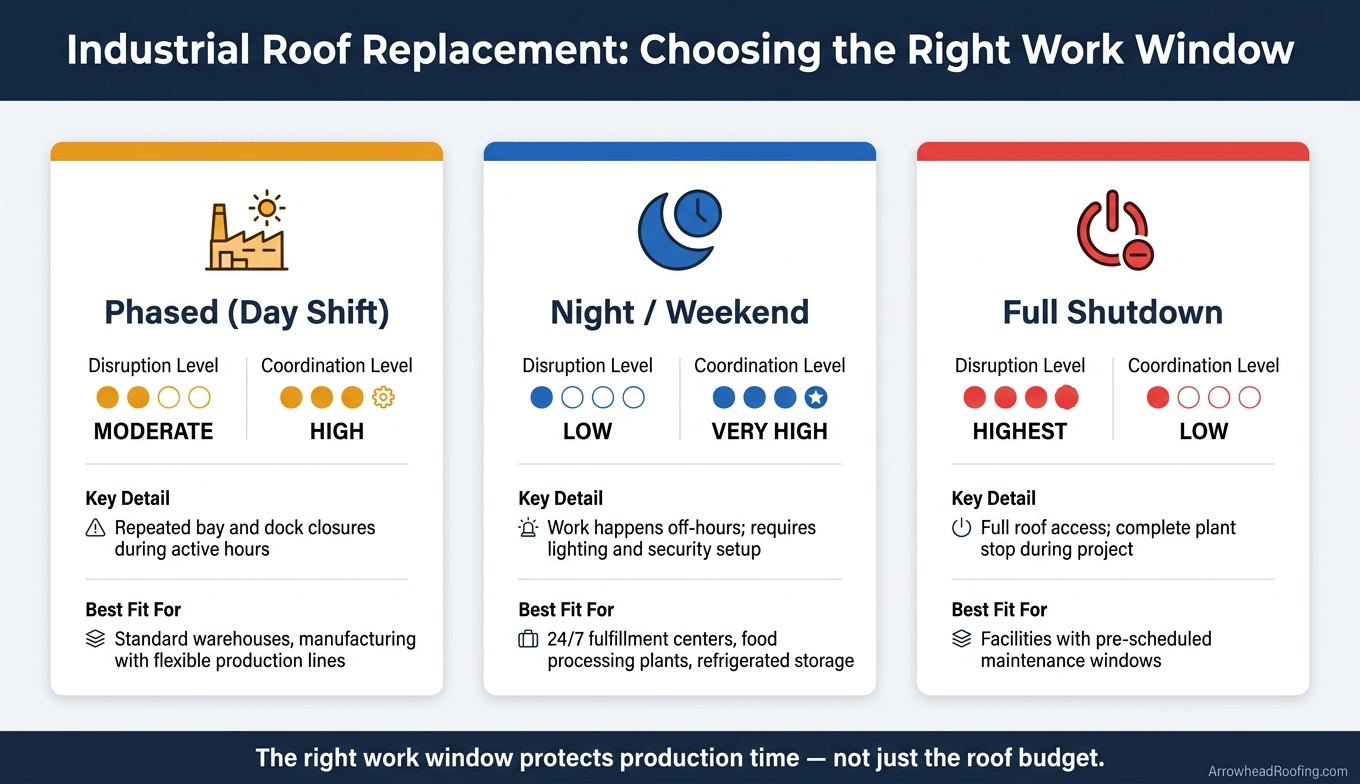
Industrial Roof Replacement: Work Window Options for Active Plants
Once we’ve mapped the bays and rooftop equipment, the next step is simple: decide when each zone can open.
Any HVAC unit above an active work zone needs to be shut down before tear-off starts in that zone.
If it stays on, it can pull dust, moisture, and fumes into the building.
That’s a headache you want to avoid.
Solvent-based adhesives used in some adhered membrane systems can create stronger odors in hot weather.
And that can shift the work window.
In practice, we may need to handle those zones early in the day or during off-shift hours to help keep odor lower inside the plant.
Get approval for each HVAC shutdown before work starts.

Off-shift work tends to fit best when a zone sits over a 24/7 fulfillment line, a food production plant with rolling shifts, or refrigerated storage where daytime disruption just won’t work.
Use the comparison below to match the work window to your plant’s access limits.
| Approach | Disruption | Coordination | Best Fit For |
|---|---|---|---|
| Phased (Day Shift) | Moderate; repeated bay and dock closures | High; requires daily coordination | Standard warehouses, manufacturing with flexible lines |
| Night / Weekend | Low; work happens during off-hours | Very high; requires lighting and security | 24/7 fulfillment, food processing, refrigerated storage |
| Full Shutdown | Highest; full access, full stop | Low; full roof access | Facilities with scheduled maintenance windows |
Before work starts, we need access, contacts, and equipment schedules.
Before we open the first bay, we need three things locked in: the access plan, shutdown contacts, and the equipment schedule.
Our commercial roofing page walks through our commercial services.
And our commercial roof replacement page shows how we handle replacement work on active plants.
A clear pre-job plan keeps roof work lined up with your daily operation.
Here are the basics we need before mobilization:
Before each shift, your facility manager and our foreman should confirm the active zone, lockout status, and any floor changes below it.
Once the site plan is set, membrane choice comes next.

TPO is the default membrane for us and makes up the large majority of our commercial work.
| Membrane | Best fit |
|---|---|
| TPO | Default membrane |
| PVC | Facilities with chemical exposure, grease, or animal fat in the exhaust stream |
| EPDM | Cold-climate or ballasted assemblies |
If you want a closer look at TPO, see our commercial TPO roofing page.
For a side-by-side comparison, read our TPO vs. EPDM vs. PVC guide.
Yes. Replacing an industrial roof while production continues takes a phased plan.
We work with your team to map out the job, set zones, and keep disruption as low as possible.
The idea is simple: break the project into smaller, manageable areas.
That way, each section is dried in and protected before we move to the next one.
In other words, we don’t tear off the whole roof at once.
We move zone by zone so your site can stay up and running with less mess, less downtime, and less risk from weather.
We take a phased, well-planned approach to keep your Tulsa operation up and running during an industrial roof replacement.
That means we split the job into manageable zones, dry in and secure each section before we move on, and work with your team around shipping schedules and day-to-day facility activity.
Request a free inspection to get started.
We use a phased approach to keep production running during an industrial roof replacement.
The work is split into manageable zones and finished one area at a time, so parts of your facility that aren’t affected can stay in use.
We also work closely with your facility team to plan around shipping schedules and production demands.
To talk through a plan for your facility, request a free inspection.
