Schedule Inspection
Use the calendar below to select a date & time convenient for you.
APPOINTMENT WINDOW: tech arrival time may vary by +/- 15 minutes (if your appointment is 9:00am, arrival window would be 8:45-9:15am)
An NDL roof warranty does not mean “everything is covered.” It means there is no $ cap on repairs that the warranty already covers.
Here’s the short version.

In other words: NDL changes the payment limit, not the list of covered problems.
But there’s a catch.
If the issue falls outside the warranty terms, $0 limit still means $0 paid.
That’s why we should separate each warranty line before we compare bids.
| Warranty Type | Backed By | Covers | Labor | Dollar Limit |
|---|---|---|---|---|
| Material | Manufacturer | Product defects | Usually not included | Often limited to material replacement |
| Workmanship | Contractor | Install errors | Usually included for covered labor issues | Varies by contractor |
| Manufacturer System (NDL) | Manufacturer | Roof system failures covered by the warranty | Included for covered repairs | No dollar limit |
The bottom line?
Before we sign, we should ask for the specimen warranty, check if it says non-prorated, confirm the maintenance rules, and get the process for roof penetrations or other trade work in writing.

Most commercial roofing bids include a warranty.
Many include more than one.
So before you compare prices, split them into three buckets.
That’s why NDL usually refers to the system warranty, not the material line or the workmanship line.
For a side-by-side look at all three layers, see our roof warranties guide and GAF warranty levels comparison.
A material warranty comes from the manufacturer.
It covers defects in the roofing product itself, such as the membrane.
But there’s a catch.
It usually does not cover the labor to remove or replace that bad material.
Read the warranty document closely and check which products are covered, along with any exclusions.
A contractor workmanship warranty comes from the installer.
It covers issues caused by how the roof was installed, not by the product itself.
In other words, this line is about installation errors, not material defects.
This is the warranty most people mean when they say NDL.
A manufacturer system warranty covers the roof system and includes materials plus labor for covered repairs.
It’s backed by the manufacturer, not the contractor.
And that’s the big difference.
Because the manufacturer stands behind it, this is the warranty people usually mean by NDL.

No dollar limit, or NDL, removes the dollar cap on covered repairs.
But that doesn’t mean it covers everything.
The line that matters is simple: what still counts as covered.
NDL pays for covered repairs without a dollar ceiling.
That’s what sets it apart from a material-only warranty.
But there’s a catch.
Other exclusions can still shrink or deny a claim.
So when we compare bids, we shouldn’t stop at the summary page.
We need to read the issued warranty itself to see what to look for in a solid roof warranty.

An NDL warranty is still a contract.
And contracts come with conditions.
Manufacturers may require routine inspections, regular maintenance, and records showing repairs or changes made on the roof.
That paperwork matters more than most people think.
If someone does unauthorized rooftop work, coverage can be limited for the area that was affected.
So before another trade touches the roof, coordinate with your roofing contractor first.
When you review bids, treat this as a warranty-line issue.
Any work done outside the approved scope can put that part of the coverage at risk.
Our commercial roof maintenance plans are built around this kind of documentation.
Keep inspection reports, photos, and repair invoices in one place.
That’s why we read the warranty line before we compare bids.
Next, compare the three warranty types side by side.
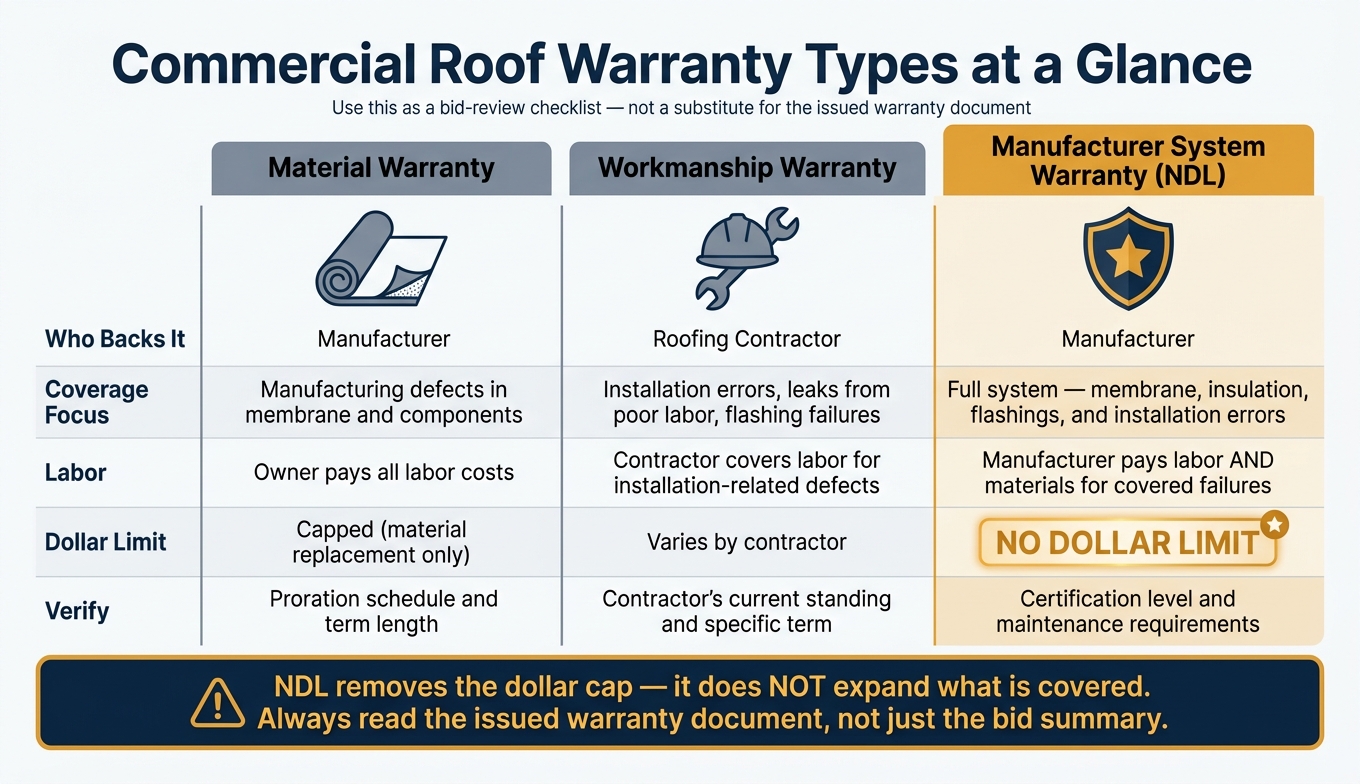
Commercial Roof Warranty Types Compared: Material vs. Workmanship vs. NDL System
Once you know NDL removes the cap, the next step is figuring out which warranty line actually gives you that promise.
This table is the fastest way to tell the three warranty types apart.
Use it as a bid-review checklist, not as a stand-in for the final issued documents.
| Warranty Type | Who Backs It | Primary Coverage Focus | Labor Treatment | Dollar Limit | Verify |
|---|---|---|---|---|---|
| Material Warranty | Manufacturer | Manufacturing defects in the roofing membrane and components | Owner pays all labor costs | Capped at replacement material only | Proration schedule and term length |
| Contractor Workmanship | Roofing contractor | Installation errors, leaks from poor labor, flashing failures | Contractor covers labor for installation-related defects | Varies and depends on the contractor’s business continuity | Current standing and specific term |
| Manufacturer System (NDL) | Manufacturer | Total system: membrane, insulation, flashings, and installation errors | Manufacturer pays labor and materials for covered failures | No Dollar Limit | Certification level and maintenance requirements |
The contractor workmanship line deserves a close look because the installer is the one standing behind it.
And there’s a catch.
The table does not show proration.
So read the document itself to confirm whether coverage stays level for the full term or drops over time.

Once you know which warranty type is on the bid, read the issued document, not the summary.
Ask for the specimen warranty, not the proposal summary.
That’s the document that shows the exclusions, maintenance rules, and definitions that control how the warranty works.
Get these points in writing:
The reason this matters is simple.
A warranty only does its job when the written terms match the bid for your commercial roof replacement.
Arrowhead Roofing is the first and only Oklahoma-headquartered GAF 3-Star President’s Club member.
That means we can offer the President’s Club Limited Warranty, the strongest warranty GAF makes.
Effective July 1, 2026, it covers workmanship for life, with 40 years non-prorated, on top of lifetime material coverage with 50 years non-prorated.
Only 3-Star President’s Club contractors are allowed to offer it.
GAF Master Elite status is held by less than 2 percent of roofing contractors nationwide.
And less than half of Master Elite contractors qualify for President’s Club.
See our roof warranties guide, and request a free inspection when you are ready.
Arrowhead Roofing is not a licensed public adjuster.
We do not negotiate insurance claims.
We provide roof inspections, document storm damage, and meet with insurance adjusters to support the inspection process.

Not always.
An NDL commercial roof warranty is backed by the manufacturer.
It can cover labor and materials for repairs or replacement when the issue comes from a manufacturing flaw or an installation defect.
A workmanship warranty, on the other hand, covers the contractor’s installation work.
But there’s a catch.
An NDL warranty often requires a manufacturer-certified contractor.
It may also leave out storm damage, poor maintenance, and unauthorized changes.
So the best option comes down to one thing: what the warranty document actually covers.
Yes. Roof penetrations can void part of an NDL commercial roof warranty if they’re added or changed outside the warranty requirements.
It usually comes down to who did the work, how it was installed, and whether the roof was kept up the way the warranty requires.
If those conditions aren’t met, you can lose coverage for the affected area, and in some cases more than that.
The safe move is simple: check your warranty documents for the exact scope, exclusions, and conditions before any penetration work happens.
Ask for the manufacturer’s warranty document before you sign.
That’s the place where you can check what the No Dollar Limit warranty covers, what it leaves out, and what you need to do to keep it active.
In most cases, these warranties cover listed material defects.
Many programs also cover listed installation defects.
Storm damage usually goes through insurance, not the warranty.
