Schedule Inspection
Use the calendar below to select a date & time convenient for you.
APPOINTMENT WINDOW: tech arrival time may vary by +/- 15 minutes (if your appointment is 9:00am, arrival window would be 8:45-9:15am)
Before we repair your Tulsa cold storage roof, we check for trapped moisture – not just surface leaks. Warm, humid air can reach cold surfaces through small gaps, leaving insulation wet even when you see no drip.
We focus on 3 connected tasks:

Our TPO membrane is one part of the system – not a substitute for insulation or vapor control.
The starting point: base the work on documented roof conditions, then use those findings to plan repairs, replacement, and maintenance plans.
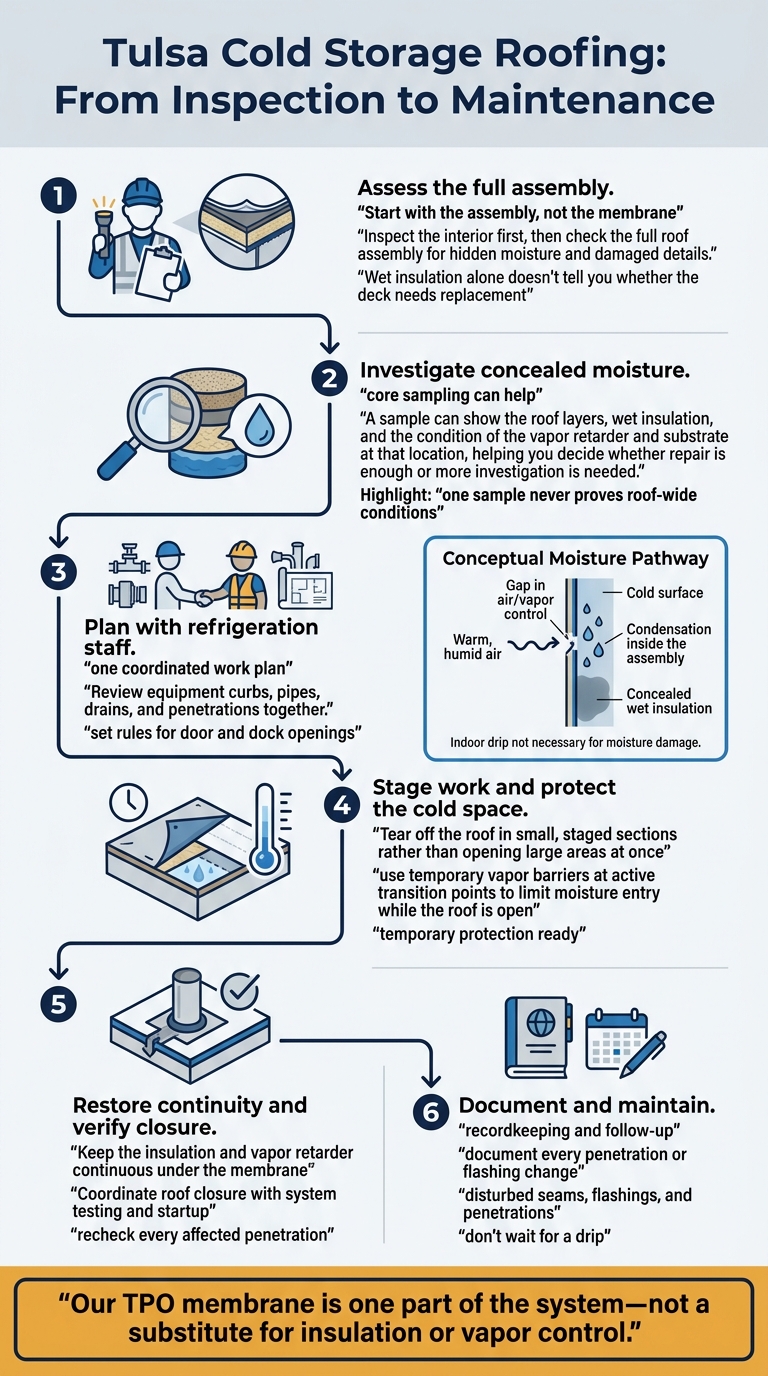
Tulsa Cold Storage Roofing: From Inspection to Maintenance
Your refrigerated facility needs a complete assembly, not just thicker insulation, with insulation and a vapor retarder placed to work together against inward vapor drive.
Stagger insulation joints so seams don’t line up through the assembly, and check the layout against the manufacturer’s technical documentation before installation.
The vapor retarder matters just as much as the insulation: it belongs on the warm side, with sealed laps, perimeters, penetrations, and roof-to-wall connections.
Wet insulation retains and releases heat differently than dry insulation, which makes concealed moisture detectable as damage progresses.
TPO is our default membrane and accounts for the large majority of our commercial work.
Our commercial TPO roofing is part of the complete assembly – not a replacement for insulation or vapor control.
Gaps in the vapor-control layer can let moisture reach cold surfaces and condense inside the roof assembly.

Your insulation can be wet even when nothing drips inside, and damage may show up there before you find the source elsewhere.
Wet insulation reads differently from dry insulation, which helps us detect hidden moisture – but finding wet material doesn’t tell us how moisture got there.
That’s why we need to look beyond the insulation and inspect the roof deck, underside, ceiling, and supporting structure for moisture, ice, rot, or deterioration.
Wet insulation alone doesn’t tell you whether the deck needs replacement, so have the deck assessed separately before roof work begins.
Our guide to when roof decking needs to be replaced explains what to check.

Hidden moisture can enter through any seam, penetration, termination, or roof-to-wall connection.
Even a small gap can let warm, humid air into the cold assembly of your Tulsa facility.
Check these spots for breaks in air and vapor control:
| Roof location | What to examine | Why it matters |
|---|---|---|
| Membrane seams and laps | Continuous seals | Gaps allow air and vapor movement |
| Curbs and penetrations | Seals, flashing, and transitions | Openings interrupt control layers |
| Roof-to-wall connections | Continuous enclosure tie-in | Gaps let air into the assembly |
| Fasteners and attachment points | Disturbed or unsealed areas | Penetrations can create moisture paths |
| Insulation joints | Staggered, offset, tightly fitted boards | Open joints allow thermal bridging and air movement |
Before repairs or new refrigeration work, have your roofing and refrigeration crews agree on how they’ll seal each opening.
Keep the insulation and vapor retarder continuous under the membrane, including beneath TPO seams and transitions.
Once those details are sealed, the next challenge is keeping the building cold while work is underway.

Before roof work starts, coordinate with your facility and refrigeration staff and set rules for door and dock openings to keep the building cold as crews work overhead.
Tear off the roof in small, staged sections rather than opening large areas at once, and use temporary vapor barriers at active transition points to limit moisture entry while the roof is open.
Use the Tulsa forecast to schedule roof openings around heat and storms, with commercial roofing protection ready if the weather changes.
Sequence the work around rooftop equipment and facility operations to keep downtime to a minimum.

Rooftop equipment creates openings that can interrupt the air and vapor control line.
Before refrigeration work starts, get your roofing and refrigeration teams aligned on one coordinated work plan covering access, flashing, and handoff points.
Review equipment curbs, pipes, drains, and penetrations together.
Plan site-specific flashing for refrigeration lines and drains, and keep the vapor retarder continuous at every penetration being worked on.
Use compatible flashing foam at curbs, penetrations, and transitions to reduce air infiltration, and protect foot-traffic areas with walk pads or pavers.
Coordinate roof closure with system testing and startup, then recheck every affected penetration after the refrigeration crew finishes.
Humidity continues to act on the roof assembly long after the crew leaves.

Persistent moisture changes how insulation holds heat, so performance gets worse over time rather than staying at the same level.
Dampness can linger in insulation and at deck connections without causing an indoor drip.
Without that warning, moisture can be harder to spot, spread more easily, and repeatedly wet the same areas.
Damp organic material and dust can also support mold growth.
Treat recurring damp spots as a source problem, not something we can fix with a patch.
Before you cover anything, have the insulation checked by experts in commercial roof insulation systems and the moisture entry point traced.
If damp spots keep returning, have the roof assessed more closely before commercial roof repair or replacement.

When damp spots keep coming back, it’s time for a full condition assessment of your Tulsa cold storage roof.
Start with the assembly, not the membrane, before choosing repair or replacement.
Inspect the interior first, then check the full roof assembly for hidden moisture and damaged details.
Professional roof inspections help distinguish urgent, localized repairs from conditions that call for replacement.
When the rooftop view doesn’t tell the whole story, core sampling can help.
A sample can show the roof layers, wet insulation, and the condition of the vapor retarder and substrate at that location, helping you decide whether repair is enough or more investigation is needed.
Treat sampling as a separate step: one sample never proves roof-wide conditions.
Bring your refrigeration team into the scope decision so you can review access, protected lines, and temperature control during roof work.
We need to base that decision on documented assembly conditions, not membrane appearance alone.
Use your roof inspection findings to ask what supports localized repair, what needs more investigation, and what concealed damage changes the scope of commercial roof replacement.
If the assembly stays in service, carry those findings into a maintenance plan.

After repairs or service work, focus on recordkeeping and follow-up.
Ask refrigeration technicians to document every penetration or flashing change, since each change can let warm, humid air reach cold surfaces inside the roof assembly.
Include interior moisture checks and access paths in your commercial roof maintenance plan.
After major service work, schedule a roof inspection to check disturbed seams, flashings, and penetrations.
Check access paths for membrane damage, and report hidden moisture or ice under the deck – don’t wait for a drip.
If the assessment supports replacement, bring your maintenance findings, equipment access needs, and building temperature control into commercial roof replacement planning.
Request a free inspection.
Condensation forms when warm, humid air meets a cold surface inside your roof assembly.
It may leave wet insulation without a drip, so moisture alone won’t tell you whether you’re dealing with condensation or a roof leak.
We check drainage and flashing and look for trapped moisture to assess your roof’s condition.
Request a free inspection.
We plan roof replacement around your facility’s daily work, but we need to assess your existing roof before we can confirm whether you can stay open.
Our plan must account for temperature control, which roof sections will be exposed at each stage, and the weather forecast.
Request a free inspection to discuss your facility.
We’ll inspect your existing roof before deciding whether we can address wet insulation without replacing the entire roof.
We check drainage, flashing, and areas of failure to understand what your cold storage facility in Tulsa needs.
Request a free inspection to discuss your facility’s needs.
