Schedule Inspection
Use the calendar below to select a date & time convenient for you.
APPOINTMENT WINDOW: tech arrival time may vary by +/- 15 minutes (if your appointment is 9:00am, arrival window would be 8:45-9:15am)
Your lease – not the “triple net” label alone – guides who pays for roof work in Tulsa. Before approving work, have your attorney review 3 areas: maintenance and repairs, the premises definition, and operating expenses.
We document the roof so you can bring clear facts to that review:
Our role is to inspect and document the roof – not interpret your lease or negotiate insurance claims.
<u>Keep roof condition, lease responsibility, and insurance coverage separate.</u>
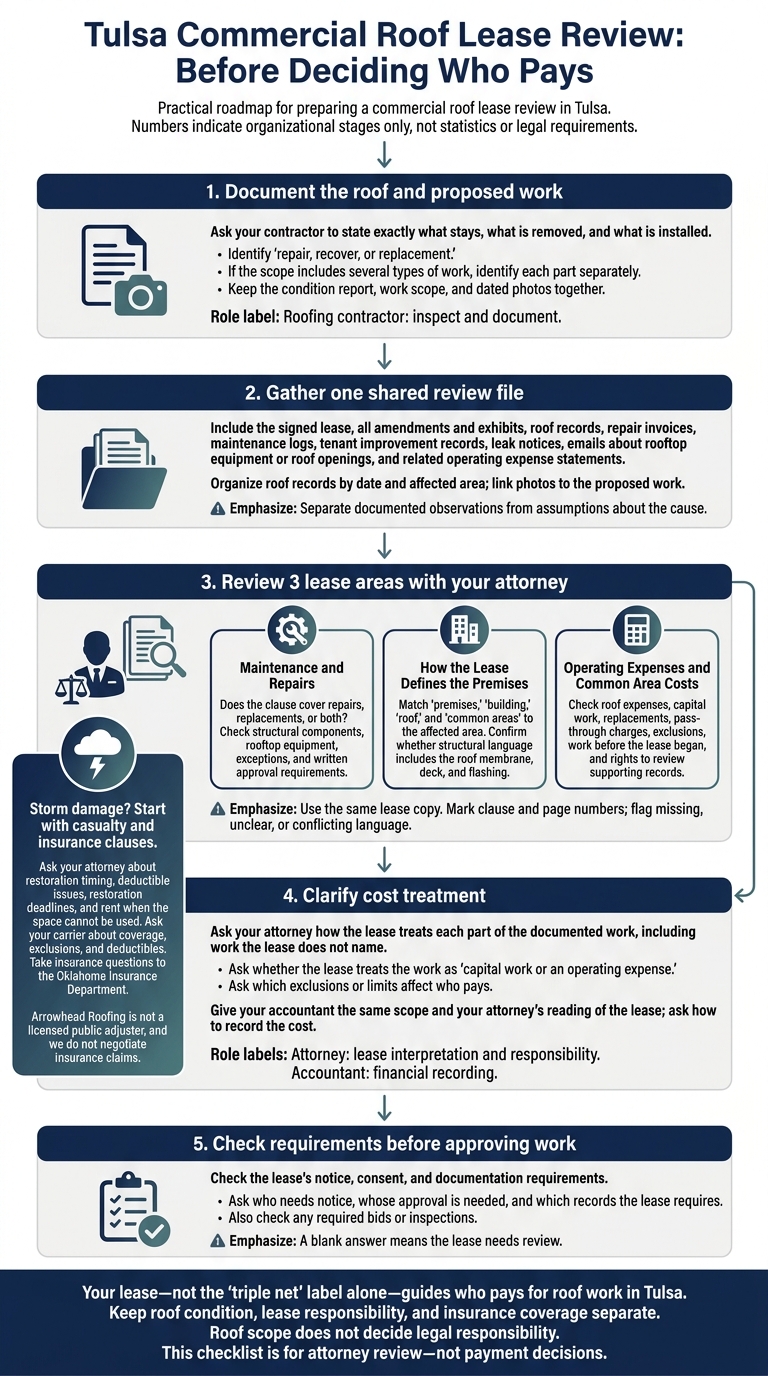
Tulsa Commercial Roof Lease Review: Before Deciding Who Pays
Review these provisions with your attorney, using the same lease copy for each clause.
Don’t rely on a “triple net” label alone.
Start with who pays: Does the clause cover repairs, replacements, or both?
Check how it handles structural components and rooftop equipment, including any exceptions that change who pays.
Also look for clauses that require the landlord’s written approval before you install rooftop equipment.
Next, check how the lease defines the space.
Match “premises,” “building,” “roof,” and “common areas” to the exact area that needs work.
Confirm whether “structural components” includes the roof membrane, deck, and flashing.
Then check who can pass the cost through.
Does the clause cover roof expenses, capital work, replacements, or pass-through charges?
Review exclusions, work done before the lease began, and any right you have to review supporting records.
Before we address payment, we need to know whether the proposed work is repair or replacement.
A vague scope can leave each side with a different understanding, so describe the work clearly enough to compare it with the lease.
Ask whether the work is repair, recover, or replacement, then compare that scope with the commercial roof repair and commercial roof replacement pages.
Ask your contractor to state exactly what stays, what is removed, and what is installed.
For a clear breakdown of these terms, read roof repair, roof recover, and roof replacement explained.
If the scope includes several types of work, ask the contractor to identify each part separately.
Give that description to your attorney and ask how the lease treats each part, including work the lease does not name.
We document the physical scope so your attorney has a clear description to use when reviewing the lease.
Once that scope is clear, the next question is how the lease treats the cost.
Ask your attorney whether the lease treats the work as capital work or an operating expense, using the documented scope to check the lease language.
Then ask your accountant how to record it, and use the checklist below to guide your review.
Once the scope is set, ask how the lease classifies the work and which exclusions or limits affect who pays.
Before approving the work, check the lease’s notice, consent, and documentation requirements.
Ask who needs notice, whose approval you need, and which records the lease requires.
Give your accountant the same scope and your attorney’s reading of the lease.
We can provide detailed estimates and scope-of-work documentation to help you organize these questions with the checklist below before deciding who pays.
Use the same lease copy to mark the clause and page number for each item before comparing the language with the roof scope.
This checklist is for attorney review – not payment decisions.
| Lease area | Questions to ask | Page no. |
|---|---|---|
| Repair clause | Does the lease treat roof repairs and replacement separately? | |
| Replacement language | Does the lease address roof replacement or restoration separately? | |
| Premises definition | Does the lease place the roof within the premises, the building, or another property area? | |
| Structural language | Which roof components fall under the lease’s structural or building envelope terms? | |
| Operating expenses | Does the lease include or exclude roof work from operating expenses or common area costs? | |
| Capital expense | How does the lease define capital expenses, replacements, or improvements? | |
| Tenant-caused damage | Does the lease address damage from tenant work, rooftop equipment, or unapproved alterations? | |
| Procedures | What notice, approvals, bids, inspections, or documentation does the lease require? | |
| Insurance and casualty | Does the lease address storm damage, casualty repairs, or insurance proceeds? |
Flag any clause that’s missing, unclear, or conflicts with another clause for your attorney.
A blank answer means the lease needs review.
If the language remains unclear, your next step is to match it to the roof condition and work scope.
We can document the roof’s condition and proposed work so both sides review the same facts before discussing who pays.
Your attorney and accountant can use those same roof records when reviewing the lease.
Keep the condition report, work scope, and photos together in one set.
The scope should name the affected areas and describe the proposed work.
These records help your attorney compare the lease language with the actual roof work before payment discussions begin.
We document the roof. Your attorney and accountant decide how to handle lease terms and financial treatment.
If the work followed storm damage, the next question is how that affects the review. You may also have questions about roof insurance claims if a storm triggered the need for repairs.
Before discussing payment, put the lease and roof records in one file.
Include your signed lease, all amendments and exhibits, roof records, repair invoices, maintenance logs, tenant improvement records, leak notices, emails about rooftop equipment or roof openings, and related operating expense statements.
These documents show what was reported, what work was done, and what was billed.
Match each record to the roof’s condition and the scope of work.
Add dated photos, the condition report, and the proposed scope of work.
Organize the records by date and affected area, and link each photo to the repair, recover, or replacement scope.
Keep records of known connections to rooftop equipment or tenant work alongside the corresponding photos.
Separate documented observations from assumptions about the cause.
Flag missing documents or conflicting descriptions for your attorney, and review the file alongside the lease before discussing payment.
After storm damage, start with the casualty and insurance clauses, not the maintenance clause alone.
If your Tulsa commercial property has roof damage, ask your attorney how those clauses affect restoration timing and any deductible issues.
Ask whether your lease sets restoration deadlines or addresses rent when you can’t use the space.
Keep lease responsibility separate from insurance coverage.
Ask your carrier about coverage, exclusions, and deductibles, and take insurance questions to the Oklahoma Insurance Department.
Arrowhead Roofing is not a licensed public adjuster, and we do not negotiate insurance claims.
We inspect roofs, document storm damage, and meet with insurance adjusters to support the inspection process.
Once you have the lease, roof records, and work scope, take the lease to your attorney to review how its maintenance, premises, and cost recovery clauses apply to the proposed roof work.
Include the condition report, photographs, and work scope in that review.
Next, ask whether the work counts as a repair or replacement, and have your attorney and accountant classify it.
Roof scope does not decide legal responsibility. We document the roof’s condition and work scope; your attorney determines responsibility under the lease.
With the facts clear, we can prepare the roof documentation and scope for your lease review.
If your lease doesn’t mention the roof, review its maintenance and repair clause, definition of the premises, and operating expense language with an attorney.
Ask how those provisions apply to roof repairs and replacement costs.
We can document the roof’s condition and provide scope-of-work documentation, but we don’t interpret your lease.
Request a free inspection.
Review your lease’s maintenance and repair terms, and ask an attorney to clarify who’s responsible.
Leases differ, and repairs may be handled differently from replacements.
We provide commercial roof inspections, detailed estimates, and scope-of-work documentation – not lease interpretation.
Request a free inspection.
Whether you can dispute the charge depends on your lease. Check how it assigns roof maintenance, repair, and replacement costs, then ask an attorney how those terms apply to your charge.
We don’t interpret your lease, but we can document the roof’s condition and provide detailed estimates and scope-of-work documentation to help you understand the work involved.
